
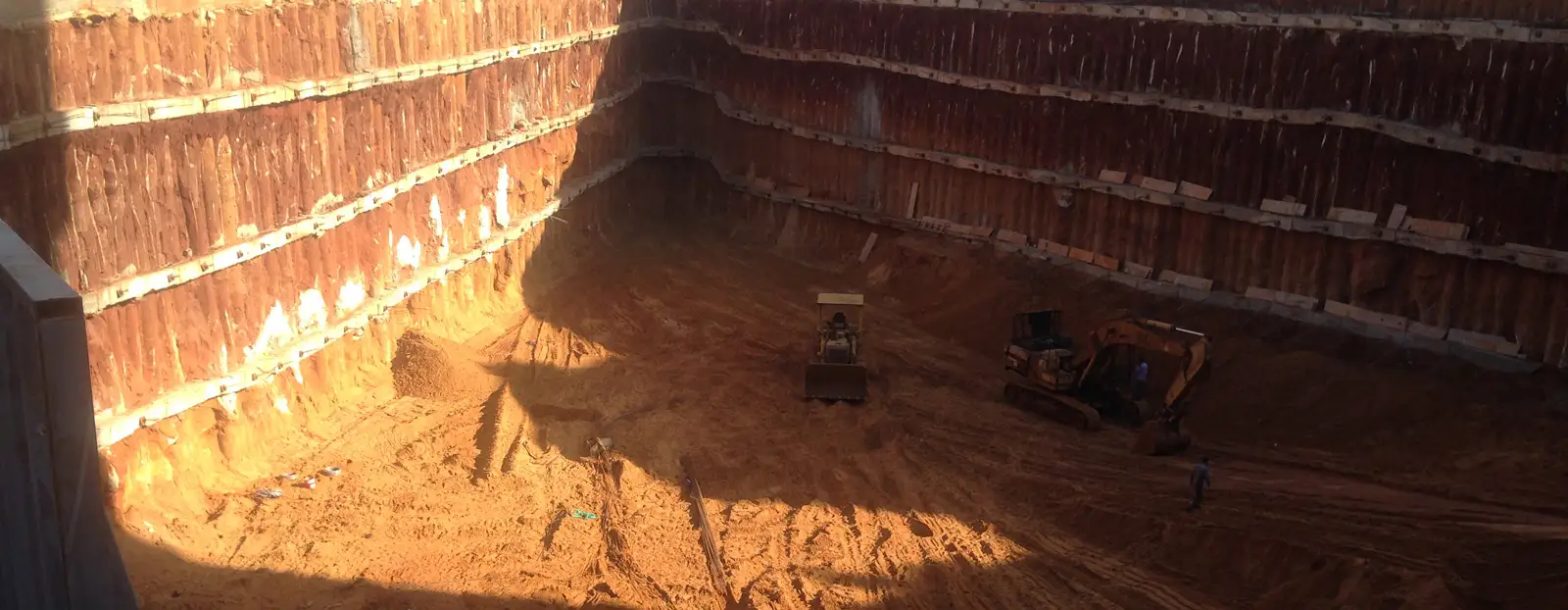
Create Continuous Retaining Support for Deep Excavations
About Secant Pile Walls
Secant pile walls are formed by constructing overlapping bored piles to create a continuous retaining system. They are commonly used where excavation support, ground retention and groundwater control need to work together, particularly on constrained urban sites or projects close to existing structures.
The wall is created through a sequence of primary and secondary piles, with reinforced piles providing structural resistance where required. The exact pile diameter, spacing, overlap, depth and reinforcement depend on excavation depth, ground conditions, groundwater and structural design requirements.
Albitar Foundations provides secant pile wall construction as part of its specialist shoring and ground-engineering capabilities in Lebanon. With experience in piling, drilling, excavation support and dewatering, the company can coordinate secant wall execution with the wider below-ground construction sequence.

1982
Established
43
+
Years of specialist experience
1200
+
Projects completed
50
+
Experienced field workers
Precision Drilling for Controlled Excavation Support
Why Choose Albitar Foundations for Secant Pile Walls
Secant pile walls depend on accurate positioning, drilling continuity and disciplined sequencing. Albitar Foundations combines specialist drilling capability with practical excavation-support experience to help deliver retaining systems suited to demanding ground and site conditions.
Specialist Piling Experience
Practical experience in piling, shoring and deep excavation support systems.
Accurate Drilling Control
Pile alignment, position and sequence are managed carefully to maintain wall continuity.
Groundwater Awareness
Secant walls can be coordinated with groundwater-control requirements where site conditions demand it.
Integrated Site Execution
Wall construction can be coordinated with excavation, anchors, dewatering and foundation works.
Secant Pile Wall Solutions for Retention, Support and Groundwater Control
What We Offer
Albitar Foundations delivers secant pile wall works for excavations that require continuous ground retention and controlled support near neighboring properties, roads or existing structures. Each solution is considered against excavation depth, soil and rock conditions, groundwater, access, structural loads and project sequencing.
What We Offer:
- Secant pile wall construction for deep excavations
- Primary and secondary bored pile sequencing
- Reinforced secant pile installation where required
- Temporary and permanent retaining wall applications
- Excavation support in dense urban or restricted sites
- Secant walls near existing buildings and property boundaries
- Retaining systems where groundwater control is an important consideration
- Drilling through varying soil and ground formations
- Coordination with ground anchors and tieback systems
- Integration with excavation and construction dewatering
- Construction planning around site access and equipment limitations
- Support for basement, infrastructure and below-ground construction
- Coordination with consultants, structural engineers and project teams

FAQs
Secant Pile Wall Questions, Answered Clearly
Secant pile walls are used where excavations require continuous structural support and controlled ground retention. These answers explain how secant walls are constructed, where they are used and how they can be integrated with other excavation-support systems.
What is a secant pile wall?
A secant pile wall is a retaining structure made from a series of overlapping bored piles. The overlap between adjacent piles creates a continuous wall that can support surrounding ground during excavation and, depending on the design and ground conditions, help reduce groundwater inflow.
When are secant pile walls used?
Secant pile walls are often used for deep excavations, basements, infrastructure works and urban projects where excavation is close to neighboring structures or property boundaries. They are especially useful when a continuous retaining wall is required.
How are secant pile walls constructed?
Construction typically starts with a sequence of primary piles, followed by secondary piles drilled between them so that they overlap. Secondary piles may be reinforced depending on structural requirements. Accurate positioning and drilling sequence are important to maintain wall continuity.
Can secant pile walls help control groundwater?
Yes. Because the piles overlap, secant walls can provide a relatively continuous barrier that may help limit groundwater entering an excavation. The degree of water control depends on pile overlap, construction quality, ground conditions and the project design, and additional dewatering may still be required.
Does Albitar Foundations provide secant pile wall services in Lebanon?
Yes. Albitar Foundations provides secant pile wall construction in Lebanon as part of its specialist shoring, piling and ground-engineering services. Secant wall works can be coordinated with excavation, anchoring, dewatering and other below-ground construction activities.
Start with the ground conditions
Planning a difficult excavation or foundation project?
Share the site constraints, project requirements and available geotechnical information. Albitar Foundations can review the challenge and help identify a technically suitable and financially practical way forward.
Albitar Foundations
Geotechnical Engineering
Shoring
Excavation
Lebanon